
FAQ
Frequently Asked Questions
Find answers to common questions about Guhe silicone sealants, products, manufacturing capabilities, and global cooperation.
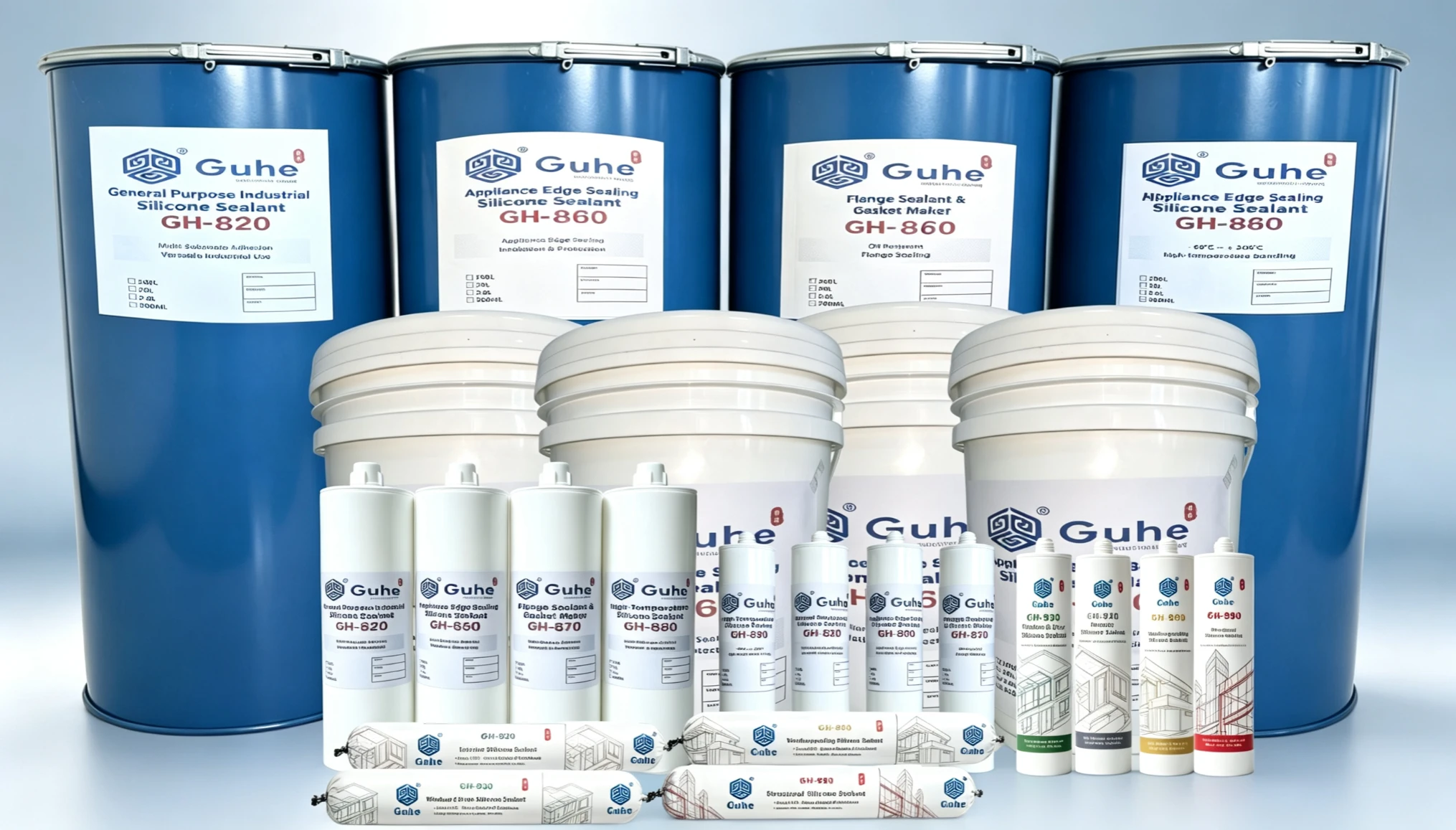
We specialize in two main categories: Building Silicone Sealants and Industrial Silicone Sealants.
Building: structural sealants, weatherproofing sealants, window & door sealants, anti-mold sealants, fire-retardant sealants, and interior sealants.
Industrial: high-temperature sealants (up to 250°C), ultra-high-temperature sealants (up to 280°C continuous, 350°C peak), appliance edge sealing sealants, flange sealants & gasket makers, and general-purpose industrial sealants.
Neutral-cure sealants release alcohols during curing – low odor, non-corrosive, suitable for interior renovation, electronics, and metal substrates. Acetoxy-cure sealants release acetic acid – has a vinegar-like odor, may be slightly corrosive to some metals, but offers faster adhesion to glass.
Yes. Our building-grade silicone sealants offer excellent weather resistance, UV stability, and durability for both indoor and outdoor use. Our weatherproofing series is specifically designed for facade and curtain wall joints.
Yes. We offer standard colors including clear, white, black, and grey. For bulk orders, we support color customization based on your samples or Pantone numbers.
12 months from the date of production, when stored in unopened original packaging in a cool, dry place (5°C to 25°C), protected from direct sunlight.
Our facility has a monthly production capacity of over 1,000 tons with a 6,000㎡ self-owned production facility.- We are fully equipped to handle large-volume orders for distributors, OEM partners, and major construction projects – with stable quality and on-time delivery guaranteed.
Structural sealant is designed for load-bearing bonding – it holds glass panels to metal frames in curtain walls, requiring high strength and high modulus. Weatherproofing sealant is designed for waterproof sealing – it seals facade joints against water and air infiltration, requiring high elasticity and UV resistance.
Our factory is located in Xinhui District, Jiangmen City, Guangdong Province, China. Factory visits are welcome. Please contact us in advance to arrange your visit.
Yes. Guhe supports customized solutions based on different application requirements, including product performance, viscosity, color, and specific usage conditions.
Our general-purpose sealants can be used continuously from -40°C to +150°C. Our high-temperature series (gh-880) withstands -60°C to +250°C. Our ultra-high-temperature series (gh-880H) delivers continuous service from -60°C to +280°C with intermittent peak resistance up to +350°C.
Standard silicone sealants are not paintable – paint will not adhere properly due to the low surface tension of cured silicone rubber. Our interior sealant (MS polymer-based) is paintable. For applications requiring painting, we recommend painting the substrate surface before applying the sealant.
Our silicone sealants offer excellent adhesion to glass, aluminum, stainless steel, ceramics, most plastics, concrete, wood, and other common construction and industrial materials. For critical applications, we recommend conducting adhesion tests before full-scale application.
Still Have Questions?
Need More Information?
Our technical and sales team is ready to provide professional silicone sealant solutions for your project.